Narrative Length Analyzer
Have you ever finished a book that felt like it dragged on forever, only to realize the author could have cut 50,000 words without losing a single plot point? Or maybe you’ve read something so brief and punchy that you wished for just one more chapter before the end? The question of narrative length isn’t just about filling pages; it’s about respecting the reader’s time while delivering a complete emotional experience. There is no magic number that makes a story good, but there are industry standards that exist for very practical reasons.
If you are looking at your blinking cursor wondering how many words you need to write, or if you are a reader trying to gauge your commitment to a new title, understanding these benchmarks changes everything. Length dictates format, format dictates market, and market dictates success. Let’s break down exactly how long different types of stories should be, why those numbers matter, and what happens when you ignore them.
The Spectrum of Story Lengths
We often think of "writing" as a monolith, but in publishing, length is the first filter editors use. A narrative is not just text; it is a product with physical and digital constraints. Print books have page count limits because paper costs money. E-books have attention span limits because readers scroll. Here is how the industry categorizes narratives based on word count.
| Format | Word Count Range | Typical Page Count (Print) | Best For |
|---|---|---|---|
| Flash Fiction | Under 1,000 words | 1-4 pages | A single moment, twist, or image |
| Short Story | 1,000 - 7,500 words | 5-30 pages | Magazines, anthologies, character studies |
| Novelette | 7,500 - 17,500 words | 30-70 pages | Complex plots that don't fit a short story |
| Novella | 17,500 - 40,000 words | 70-160 pages | Standalone tales, limited POV |
| Novel | 40,000+ words | 160+ pages | Full world-building, ensemble casts |
Notice where the lines blur. A 39,000-word manuscript is technically a novella, but most traditional publishers will reject it because it’s too thin to justify a hardcover price tag yet too long to sell as a cheap paperback. This "no-man's land" between 30,000 and 40,000 words is where many debut authors get stuck. They have written a substantial story, but it doesn't fit the commercial boxes.
Genre Expectations: Why Fantasy Runs Longer Than Thrillers
You cannot judge a fish by its ability to climb a tree, and you cannot judge a fantasy epic by thriller standards. Different genres promise different experiences, and those experiences require different amounts of space. If you pick up a horror novel expecting 800 pages of lore, you’re going to be disappointed. If you pick up a high-fantasy saga expecting 200 pages of action, you’ll feel cheated.
Here is what readers and agents expect from specific genres in 2026:
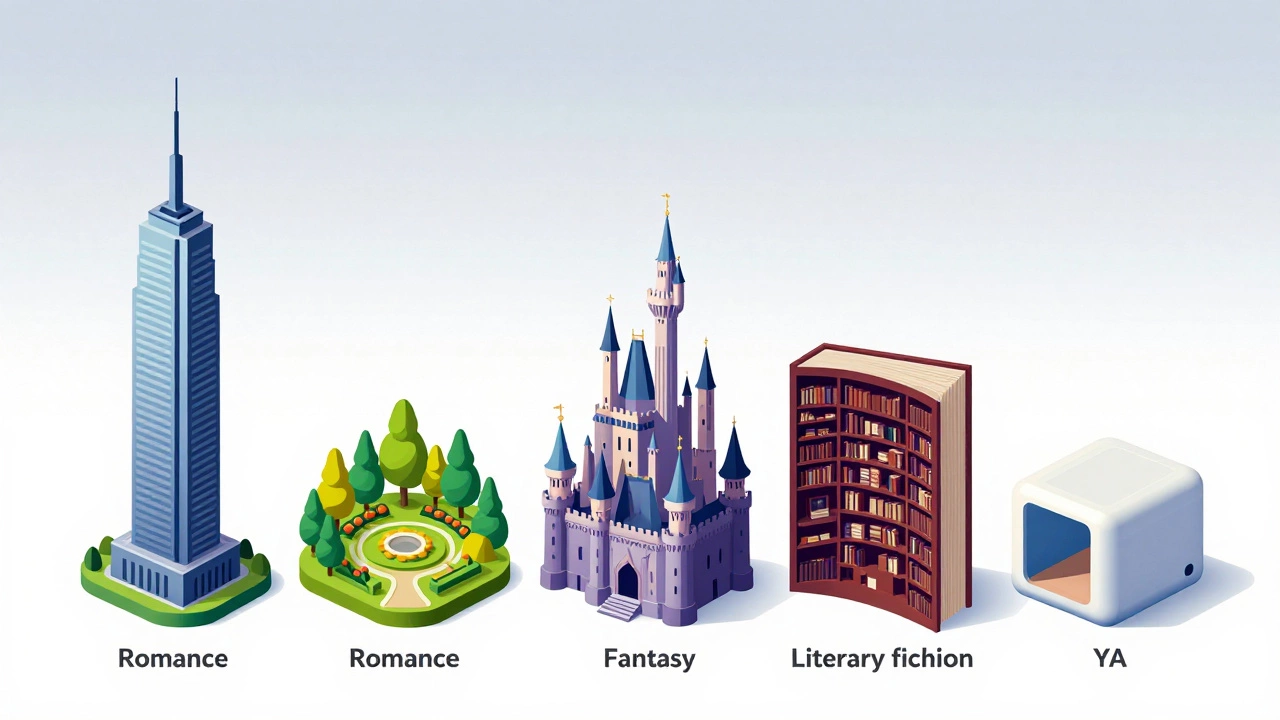
- Thriller & Mystery: These rely on pace. Readers want tension, not exposition. The sweet spot is 70,000 to 90,000 words. Anything over 100,000 words risks slowing down the plot. Think of Dan Brown or Gillian Flynn; their books move fast because they trim the fat.
- Romance: Romance readers are voracious. They read quickly and buy frequently. Standard length is 50,000 to 90,000 words. However, "Romantic Suspense" leans toward the higher end (80k-100k) to accommodate the mystery plotline.
- Science Fiction & Fantasy: World-building takes time. You need to explain magic systems, political structures, and alien cultures. Agents accept 90,000 to 120,000 words for debuts. Established authors like George R.R. Martin can go much longer, but newcomers who submit 150,000-word manuscripts are often told to cut it in half.
- Literary Fiction: This genre focuses on character interiority and prose style rather than plot velocity. Length varies wildly, but 60,000 to 100,000 words is common. The focus is on depth, not breadth.
- Young Adult (YA): YA readers have shorter attention spans and busier lives. The standard is tight: 50,000 to 80,000 words. Even heavy hitters like John Green stay within this range. Going over 90,000 words signals to editors that you might not understand your audience.
Why does this matter? Because an editor reading a 120,000-word thriller knows immediately that the pacing is likely off. They aren’t rejecting the idea; they are rejecting the execution. Knowing these numbers helps you self-edit before you even query an agent.
The Economics of Page Count
It feels artistic to say, "The story is the story, let it be whatever length it needs." But publishing is a business. Physical books have a "trim size" (the dimensions of the book). A standard trade paperback is roughly 6x9 inches. To make the production cost viable, a book usually needs to be between 200 and 300 pages. If your manuscript is 100,000 words, that translates to roughly 300-400 pages depending on font and spacing. That’s a thick book. Thick books cost more to print and ship. Retailers hesitate to stock them because they take up shelf space and sit unsold longer.
Conversely, a 40,000-word novel prints to about 120 pages. It looks flimsy. Readers perceive value in thickness. A thin book priced at $15 feels like a rip-off compared to a thick book at the same price. This is why novellas struggle in traditional publishing-they are hard to price and position. However, in the digital realm, this constraint vanishes. An e-book of 40,000 words sells perfectly fine at $2.99. The medium dictates the acceptable length.
Debut Authors vs. Established Stars
There is a double standard in narrative length, and it favors famous authors. When Stephen King writes a 1,000-page novel, it becomes a bestseller. When an unknown writer submits a 1,000-page manuscript, it gets rejected. Why? Trust. Established authors have earned the right to ramble because their fans trust them to deliver quality regardless of length. Debut authors have no such currency.
If you are new to writing, keep it tight. Editors are taking a risk on you. A concise, well-paced 70,000-word thriller shows you know how to control a narrative. A bloated 110,000-word draft suggests you don’t know when to stop. Save the epic sprawl for your third book, after you’ve proven you can hold a reader’s attention in a tighter frame.
When to Break the Rules
Rules exist to be broken, but only when you have a compelling reason. Sometimes a story demands extra length. Perhaps you are writing historical fiction set during the French Revolution, and you need to detail the social hierarchy to make the conflict resonate. In that case, pushing to 110,000 words might be justified. But you must ensure every word earns its place. Extra length should add depth, not drag.
On the flip side, some stories are inherently short. A poignant slice-of-life piece about a breakup might only need 5,000 words. Stretching it to 40,000 would ruin it by adding filler scenes that dilute the emotional impact. Flash fiction has exploded in popularity on platforms like Twitter (now X) and TikTok, where writers craft entire narratives in 280 characters or less. This proves that length is secondary to impact. If you can tell the whole story in 500 words, do it. Don’t pad it out to hit an arbitrary novel threshold.

Practical Tips for Managing Length
If you find yourself stuck in the middle-your story is too long for a short story but too short for a novel-you have two choices. Expand or contract. Here is how to decide:
- Analyze the Plot Holes: If your story feels thin, ask if there are missing perspectives. Could a subplot involving a secondary character add necessary context? If yes, expand. If no, you probably just need to edit tighter.
- Check the Pacing: If your story drags, look for "telling" instead of "showing." Are you explaining backstory in paragraphs when a single dialogue line could reveal it? Cut the explanation. Keep the scene.
- Consider Serialization: If your narrative is 60,000 words, consider splitting it into two novellas or a series of linked short stories. This works well for online publication or audio platforms like Audible Originals, which thrive on bite-sized content.
- Use the "Kill Your Darlings" Method: Go through your manuscript and highlight any scene that doesn’t advance the plot or develop character. Delete it. You’ll be surprised how much bulk disappears.
Remember, the goal is not to hit a word count. The goal is to tell the story as efficiently as possible while maintaining emotional resonance. Word counts are guidelines, not laws. But ignoring them entirely can hurt your chances of being taken seriously in the industry.
Conclusion: Find Your Story’s Natural Rhythm
So, how long should a narrative be? It should be as long as it needs to be to satisfy the promise made to the reader. If you promise a quick scare, give them 30,000 words of tension. If you promise a sweeping adventure, give them 100,000 words of discovery. Respect the genre conventions, respect the economics of publishing, and most importantly, respect your reader’s time. Write tightly, edit ruthlessly, and let the story dictate its own boundaries.
What is the minimum word count for a novel?
Generally, 40,000 words is considered the absolute minimum for a novel. Below that, it is classified as a novella. However, for traditional publishing, aiming for at least 50,000 to 60,000 words is safer to ensure the book has enough substance for a standard print run.
Is a 200-page book considered long?
A 200-page book is considered average to slightly short in the adult fiction market. Most novels range from 250 to 350 pages. A 200-page book typically contains around 50,000 to 60,000 words, which is perfect for thrillers, romance, or young adult fiction, but might be seen as too brief for epic fantasy.
Can I publish a 10,000-word story as a book?
Yes, but it will be categorized as a novella or short story collection. Traditional publishers rarely print standalone 10,000-word books due to low perceived value. However, self-publishing via Amazon Kindle Direct Publishing allows you to release short works easily, especially if you bundle several stories together or offer them at a lower price point.
Why do fantasy novels tend to be longer than other genres?
Fantasy requires extensive world-building. Authors must describe unique geographies, magic systems, political factions, and cultural norms that do not exist in the real world. This exposition takes up significant word count. Additionally, fantasy often features large ensemble casts and complex multi-threaded plots, which naturally expand the narrative length.
Does word count affect my royalty payments?
In traditional publishing, royalties are usually based on the final sale price of the book, not the word count. However, advanced payments may sometimes be influenced by projected page counts because thicker books cost more to produce. In self-publishing, particularly on Amazon KDP, you are paid based on the percentage of list price, so length indirectly affects pricing strategy but not the royalty rate itself.