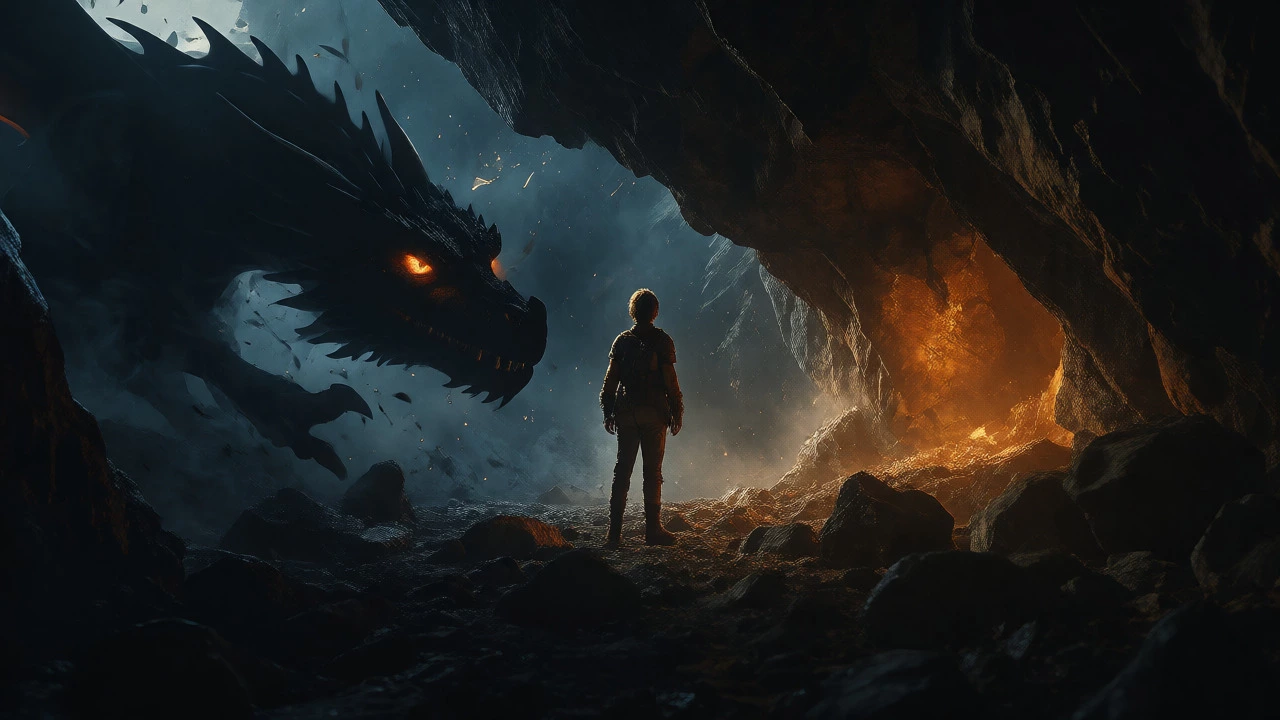
Interactive Fiction Simulator
Read the scenario below and make a choice. Watch how your decisions lead to different endings.
You’re standing in front of a dark cave. To the left, you hear the distant roar of a dragon. To the right, a faint glimmer suggests treasure. You have to pick one. If you pick wrong, you might die. If you pick right, you find gold. This isn’t just a daydream; it’s the core mechanic of a Make Your Own Adventure story. It’s a genre that blurs the line between reading and playing, handing the steering wheel directly to you.
If you’ve ever picked up a book with those iconic red-and-white covers or played a text-based game on an old computer, you’ve encountered this format. But what exactly makes these stories tick? Why do they still hold appeal in an era of high-definition video games? Let’s break down the anatomy of interactive fiction, how it works, and why it remains a powerful tool for creativity and engagement.
The Core Concept: Agency Over Plot
Traditional novels are linear. The author decides everything: who lives, who dies, and where the hero ends up. You, the reader, are a passenger. In a make-your-own-adventure story, you are the driver. The fundamental shift here is agency. The narrative structure is non-linear, built on decision points rather than a single thread.
At its simplest, a make-your-own-adventure story consists of short text segments called "paragraphs" or "sections." Each section ends with a choice. For example: "If you want to open the door, turn to page 45. If you want to run away, turn to page 12." This structure forces you to engage actively with the text. You aren’t just consuming information; you are shaping the outcome. This active participation creates a stronger emotional connection to the character because their fate is literally in your hands.
A Brief History of Branching Narratives
While the term "Make Your Own Adventure" is trademarked by Bantam Books (and later associated with the Choose Your Own Adventure series), the concept of interactive storytelling is older. The first major wave hit in the late 1970s and 1980s. Edward Packard created the original concept, aiming to let children control the action in stories they loved.
This wasn’t just a fad. It sparked a literary revolution. Authors like R.A. Montgomery and Jennifer Greene wrote hundreds of titles. The format expanded beyond books into video games, known as Interactive Fiction or IF. Text adventures like Zork used similar logic but required typing commands instead of turning pages. Today, the spirit lives on in visual novels, mobile apps, and complex RPGs like Baldur’s Gate 3, which feature thousands of branching dialogue options.
How the Mechanics Work: Nodes and Edges
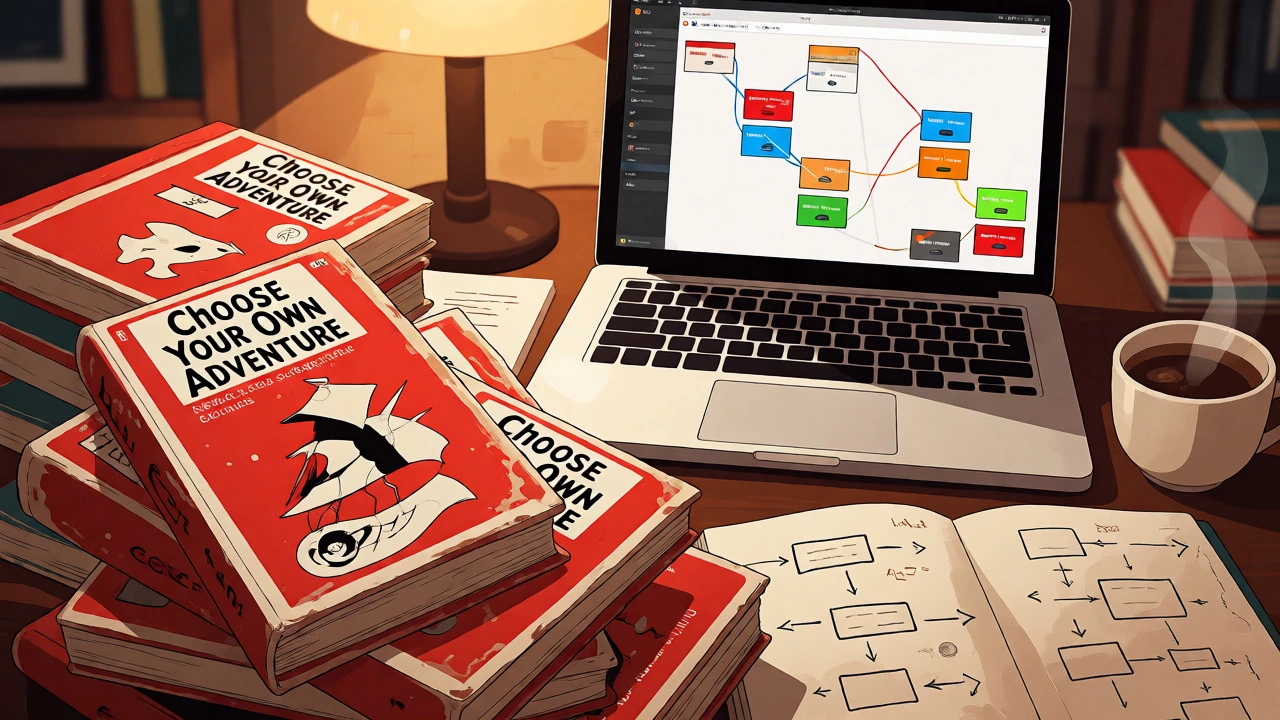
To understand how these stories are constructed, think of them as a map. In computer science terms, this is a directed graph. Each paragraph is a "node," and each choice is an "edge" leading to another node. Some nodes lead to more choices. Others lead to endings.
There are two main types of structures:
- The Tree Structure: Choices branch out but never reconverge. This requires massive writing effort because every path needs unique content. It offers high variety but can feel shallow if paths are too short.
- The Network Structure: Different choices lead back to common plot points. This is more efficient for writers. It allows for "hub" scenes where multiple routes meet before diverging again. This structure feels more cohesive and realistic.
Most modern digital interactive stories use network structures. They track variables-like health, inventory, or relationship scores-to determine which options appear. If you forgot to pick up the key in Chapter 1, the door in Chapter 5 might remain locked, even if you chose the right dialogue option.

Why Readers Love Them: The Psychology of Choice
Why do we care if a fictional character opens a door? Because we fear making the wrong mistake ourselves. Psychologists call this "loss aversion." We hate losing progress. In a make-your-own-adventure story, death or failure isn’t just a plot point; it’s a personal failure. This raises the stakes dramatically.
Furthermore, these stories offer replayability. A standard novel has one ending. A good interactive story might have ten, twenty, or fifty. Readers often race to find the "best" ending or uncover hidden secrets. This transforms reading from a passive activity into a puzzle-solving experience. It satisfies the human desire for mastery and exploration.
Digital Evolution: From Paper to Pixels
Paper gamebooks had limitations. You couldn’t easily save your state without marking pages. Digital platforms removed these barriers. Tools like Twine allow anyone to create branching narratives without coding knowledge. Twine uses a simple visual interface where you drag boxes (passages) and connect them with lines (links). It democratized interactive fiction, letting hobbyists publish complex stories on platforms like itch.io.
Mobile apps took it further. Apps like Choice of Games integrate stats, inventory management, and random number generators. You might fail a persuasion check not because you chose the wrong word, but because your character’s "Charisma" stat was too low. This adds a layer of role-playing depth that paper books struggled to replicate fairly.
Creating Your Own: Tips for Writers
Want to write your own branching tale? Here are three rules to avoid common pitfalls:
- Keep Choices Meaningful: If both options lead to the same next scene, the choice is fake. Players notice this quickly. Even small differences-a different line of dialogue or a minor item gain-make the choice feel real.
- Manage Complexity: Don’t branch too early. If every sentence splits into two paths, you’ll need to write a novel-length manuscript for a short story. Group minor decisions together or delay branching until significant plot junctures.
- Provide Feedback: When a player makes a choice, show the consequence immediately. Did they insult the king? Show his angry face. Did they heal their wound? Describe the relief. Silent consequences confuse readers.
Comparison: Traditional vs. Interactive Stories
| Feature | Traditional Novel | Make Your Own Adventure |
|---|---|---|
| Reader Role | Passive Observer | Active Participant |
| Structure | Linear (Start to Finish) | Non-Linear (Branching Paths) |
| Endings | Single Fixed Ending | Multiple Possible Endings |
| Replay Value | Low (Usually read once) | High (To explore all paths) |
| Author Control | Total Control over Plot | Control over Options, Not Outcome |
Common Misconceptions
Some people think interactive fiction is just "gamified reading." It’s not. The goal isn’t always to win. Many modern interactive stories, like Depression Quest, focus on emotional resonance rather than victory conditions. The choices reflect internal struggles, not external battles. The "ending" might simply be accepting help. This shifts the metric from success to understanding.
Another myth is that these stories lack literary quality. Early gamebooks were often formulaic. However, contemporary works like 80 Days or Hades demonstrate deep world-building and character development. The medium has matured. It’s no longer just for kids looking for a quick thrill; it’s a sophisticated narrative form capable of handling complex themes.
Getting Started: Where to Look
If you’re new to the genre, start with classics to understand the roots. Pick up a vintage Choose Your Own Adventure book. Then, try a modern digital equivalent. Search for "interactive fiction" on Steam or itch.io. Look for tags like "visual novel," "text adventure," or "choose your own adventure." Pay attention to reviews mentioning "branching paths" or "multiple endings." These indicators signal a true interactive experience rather than a linear story with occasional choices.
Remember, there is no wrong way to enjoy these stories. You can rush to the end, backtrack to see missed scenes, or obsess over collecting every item. The freedom is the point. So, grab a book-or a controller-and decide: do you turn left or right?
Is "Make Your Own Adventure" a specific brand?
Yes, "Choose Your Own Adventure" is a registered trademark originally owned by Bantam Books. However, the term "make your own adventure" is often used generically to describe any interactive narrative where the reader selects the plot direction. Other publishers have their own branded series, such as "Fighting Fantasy" or "Lone Wolf."
Do I need programming skills to create one?
Not necessarily. Tools like Twine use a visual, drag-and-drop interface that requires no coding. More advanced engines like Ink or Yarn Spinner require basic scripting, but many templates exist for beginners. Paper gamebooks only require strong organizational skills and a clear outline.
Are these stories only for children?
No. While the genre started with children’s literature, it has evolved significantly. There are now complex adult-oriented interactive novels dealing with romance, horror, mystery, and philosophical dilemmas. Platforms like Choice of Games specialize in mature themes suitable for adults.
What happens if I make a "bad" choice?
In traditional gamebooks, bad choices often lead to immediate death or failure, requiring you to restart. In modern digital versions, bad choices usually lead to negative consequences, altered relationships, or alternative endings rather than instant game overs. This encourages experimentation without frustration.
Can I save my progress in a paper gamebook?
Paper gamebooks don’t have automatic saves. You must manually track your position, inventory, and health on scratch paper. This was a major limitation compared to digital versions, which auto-save frequently. Some modern reprints include bookmark tabs to help manage navigation.