
Story vs. Narrative Visualizer
Select an Example
Click to see how adding "cause" transforms a list of events into a narrative.
Think about the last time you told someone how your day went. You didn't just list facts like "I woke up. I drank coffee. I drove to work." You probably said something like, "I was running late because my alarm didn't go off, so I had to sprint for the bus while holding my latte." That sequence-cause and effect, tension and resolution-is a narrative. It’s not just a fancy word for "story." It’s the specific way we organize events to give them meaning.
If you’re asking what an example of a narrative is, you might be looking for a simple definition or a concrete breakdown of how stories work. Whether you are a student analyzing literature, a marketer trying to sell a product, or just someone curious about why humans love gossip, understanding the mechanics of narrative is key. Let’s look at real-world examples, from ancient myths to modern marketing emails, to see how this works in practice.
The Core Definition: More Than Just a Story
Narrative is a structured account of connected events, experiences, or ideas that create a coherent whole. Unlike a random collection of facts, a narrative has a beginning, middle, and end. It usually features a protagonist (someone or something acting) and a conflict (a problem to solve).
To understand a narrative, you have to separate it from a "plot." This distinction comes from literary theorist E.M. Forster. He famously said, "The king died and then the queen died" is a story. But "The king died, and then the queen died of grief" is a plot-and thus, a stronger narrative. The second version adds causality. It answers "why."
Every narrative relies on three pillars:
- Chronology: Events happen in a sequence.
- Causality: One event triggers the next.
- Perspective: Someone is telling the tale (the narrator).
When any of these are missing, you don’t have a narrative; you have a list. A grocery list is not a narrative. A diary entry where you describe your feelings without context is barely a narrative. But a diary entry where you explain *why* you felt sad after seeing an old photo? That’s a narrative.
A Classic Literary Example: The Hero’s Journey
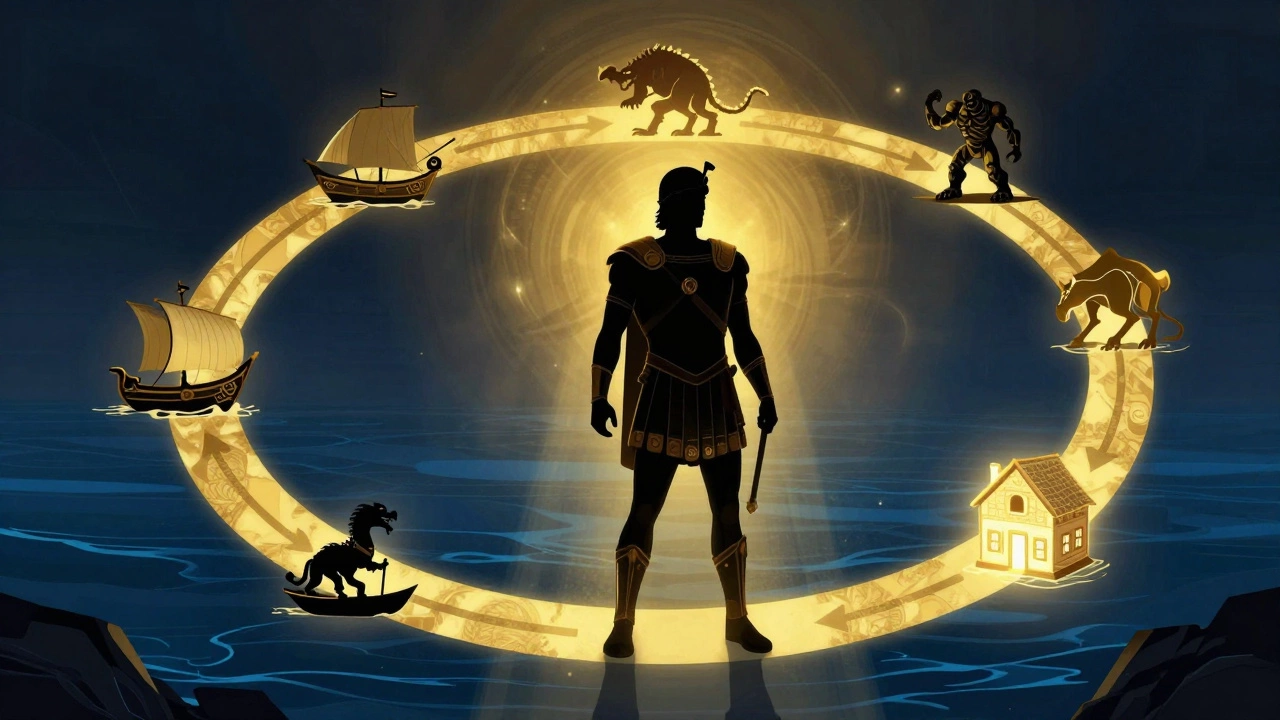
When people ask for an example of a narrative, they often think of books or movies. The most recognizable structure here is the Hero’s Journey, also known as Monomyth. This isn’t just a trope; it’s a psychological template found in cultures worldwide, from Greek myths to Star Wars.
Let’s break down The Odyssey by Homer as a clear example:
- The Status Quo: Odysseus is home with his family.
- The Inciting Incident: The Trojan War starts, pulling him away.
- Rising Action: He faces monsters, gods, and temptations during his ten-year journey home.
- The Climax: He returns to Ithaca and confronts the suitors taking over his house.
- Falling Action: He defeats the suitors and reveals his identity to his wife, Penelope.
- Resolution: Peace is restored, and he resumes his role as king and husband.
This structure works because it mirrors human growth. We leave our comfort zones, face challenges, change, and return different. If you strip away the magic and the gods, the narrative remains intact. That’s the power of the structure.
Non-Fiction Narratives: Memoirs and Journalism
Narratives aren’t limited to fiction. In fact, non-fiction often uses narrative techniques to make dry facts memorable. Think of a memoir. James Baldwin’s The Fire Next Time isn’t just a political essay; it’s a narrative of his upbringing in Harlem, his relationship with his father, and his awakening to racial injustice. The personal story drives the political argument.
Even news reporting uses micro-narratives. A headline like "Local Man Saves Dog from Flood" implies a narrative structure:
- Protagonist: Local man.
- Conflict: Flood threatens dog.
- Action: Man rescues dog.
- Resolution: Dog is safe.
Without this structure, the report would just be: "Flood occurred. Dog present. Man present." Boring, right? The narrative gives us emotional stakes.
Cultural Narratives: The Stories We Live By
Sometimes, "narrative" refers to broader societal beliefs. These are called Cultural Narratives. They are the shared stories a society tells itself about who it is, what it values, and how the world works. You don’t read these in a single book; you absorb them through media, education, and conversation.
Consider the "American Dream" narrative. It suggests that anyone, regardless of background, can achieve success through hard work. This is a powerful narrative because it provides hope and direction. However, when reality contradicts the narrative (e.g., systemic barriers prevent upward mobility), people experience cognitive dissonance. They feel confused or angry because the story doesn’t match their lived experience.
Another example is the "Self-Made Entrepreneur" narrative. Tech culture often promotes the idea that billionaires succeeded solely due to their genius and hustle, ignoring factors like inheritance, timing, or government subsidies. Recognizing these as *narratives* rather than *facts* helps you analyze them critically. Ask yourself: Who benefits from this story? What evidence supports or refutes it?
Marketing Narratives: Selling with Story
If you’ve ever bought a pair of sneakers because an ad showed an athlete overcoming injury to win a race, you’ve been influenced by a marketing narrative. Brands know that people don’t buy products; they buy better versions of themselves. The narrative bridges the gap between the product and that desired identity.
Take Nike’s "Just Do It" campaign. It’s not really about shoes. It’s a narrative about perseverance, discipline, and athletic greatness. When you wear the logo, you’re aligning yourself with that story. Apple does this too. Their ads rarely list specs first. They show creative people using Macs to make art, music, or films. The narrative is: "Apple tools enable creativity."
Here’s how to spot a marketing narrative:
- Identify the Hero: Is it the brand or the customer? (Good marketing makes the customer the hero.)
- Identify the Villain: Is it boredom, inefficiency, insecurity, or a competitor?
- Identify the Guide: How does the product help the hero defeat the villain?
If you can map an ad to this structure, you’re seeing the narrative engine behind the sales pitch.
Personal Narratives: Identity and Memory
We all construct personal narratives to make sense of our lives. Psychologists call this "narrative identity." It’s the internal story you tell yourself about who you are. Are you the "survivor"? The "underdog"? The "black sheep"? These labels shape your behavior.
For example, if your personal narrative is "I’m bad at math," you’ll likely avoid math-related tasks, confirming the belief. If you shift the narrative to "I struggle with math but I’m improving," you open space for growth. Therapists often use narrative therapy to help clients rewrite harmful stories. Instead of saying "I am depressed," a client might say "I am experiencing a period of depression." This small linguistic shift separates the person from the problem, giving them agency.
Your personal narrative is flexible. It changes as you gain new experiences. A job loss might initially fit into a "failure" narrative, but later, it could become part of a "reinvention" narrative. The events are the same; the meaning you assign to them changes.

How to Craft Your Own Narrative
Whether you’re writing a novel, a business proposal, or a dating profile, crafting a compelling narrative follows a few basic steps. You don’t need to be a writer to do this well.
- Start with the End in Mind: What do you want the audience to feel or believe? This is your theme.
- Introduce a Conflict: No conflict, no story. Even in a happy memory, there should be some tension-a missed train, a sudden rainstorm, a misunderstanding.
- Show, Don’t Tell: Instead of saying "He was nervous," describe his sweaty palms or shaky voice.
- Create Stakes: Why does this matter? What happens if the protagonist fails?
- Resolve the Tension: Provide closure. It doesn’t have to be happy, but it must feel complete.
Try this exercise: Take a boring event, like waiting in line at the DMV. Turn it into a narrative. Who is in front of you? What are they arguing about? How does the delay affect your day? Suddenly, the mundane becomes interesting because you’ve added character, conflict, and consequence.
Common Pitfalls in Narrative Construction
Even experienced storytellers fall into traps. Here are the most common ones to avoid:
- Info-dumping: Pausing the action to explain backstory. Keep exposition woven into the scene.
- Passive Protagonists: Things happening *to* the character rather than the character making choices. Active decisions drive narrative forward.
- Unearned Resolutions: Solving the conflict too easily. The solution should come from the character’s growth or sacrifice.
- Inconsistent Tone: Switching from comedy to tragedy without warning confuses the audience.
Editing is where narratives tighten. Cut anything that doesn’t advance the plot or reveal character. If a scene can be removed without changing the outcome, it’s probably fluff.
Why Narratives Matter in a Digital Age
In an era of short-form content and algorithmic feeds, long-form narratives might seem outdated. But they’re more important than ever. Attention spans are shrinking, but the desire for meaning isn’t. People scroll past headlines but stop for stories that resonate emotionally.
Podcasts like This American Life thrive because they package complex social issues into personal narratives. Documentaries use narrative arcs to engage viewers with factual content. Even scientific papers are becoming more narrative-driven to increase citations and impact. Researchers who frame their findings as a "journey of discovery" rather than a dry data dump get more attention.
Understanding narrative helps you cut through the noise. It allows you to communicate clearly, persuade effectively, and connect deeply. Whether you’re explaining a budget to your boss or sharing your life story with a friend, the principles remain the same: start with a hook, build tension, and deliver resolution.
What is the difference between a story and a narrative?
A story is a simple sequence of events (A happened, then B happened). A narrative adds structure, causality, and perspective to those events, explaining *why* they happened and *how* they connect. All narratives contain stories, but not all stories are fully developed narratives.
Can a narrative be non-linear?
Yes. Non-linear narratives jump around in time, using flashbacks, flash-forwards, or fragmented scenes. Films like Pulp Fiction or novels like Slaughterhouse-Five use non-linear structures. Despite the scrambled timeline, they still follow causal logic and character development, which keeps them coherent as narratives.
What are the main types of narrative perspectives?
The three main perspectives are: First-person ("I"), where the narrator is a character in the story; Third-person limited ("He/She"), where the narrator knows one character’s thoughts; and Third-person omniscient, where the narrator knows everyone’s thoughts and feelings. Each choice affects how much the audience knows and trusts the narrator.
How do cultural narratives influence politics?
Political leaders use cultural narratives to frame policies. For example, describing immigration as a "crisis" versus an "opportunity" activates different cultural stories about safety, economy, and identity. Voters respond to these narratives emotionally before analyzing the policy details, making narrative control a key part of political strategy.
Is social media post a narrative?
Individual posts are usually fragments, but a curated feed or thread can form a micro-narrative. Influencers often craft a "day in the life" narrative across multiple posts, showing a problem (morning rush), action (workout/coffee), and resolution (successful day). Even a single tweet can be a narrative if it sets up a joke (setup) and delivers a punchline (resolution).