Titanic Fact vs. Fiction Explorer
The Band's Final Song
In the Film:The band plays "Nearer, My God, to Thee" as the ship sinks.
Historical Fact:Survivor accounts suggest they played lighter tunes like "Autumn" or "Lower, Deeper Down" to maintain morale.
The Iceberg Collision
In the Film:A sudden, violent impact with massive debris flying through the air.
Historical Fact:It was a gentle scrape along the starboard side that opened seams and rivets, allowing water to pour in gradually.
J. Bruce Ismay's Actions
In the Film:Depicted as a coward who sneaks onto a lifeboat while others perish.
Historical Fact:He followed "women and children first" protocol, offered his seat to women, and was assisted by crew members.
Jack on the Door
In the Film:Jack cannot fit on the floating door and freezes to death in the water.
Historical Fact:Physics experts confirm the panel had enough buoyancy for both passengers, but narrative necessity required Jack's death.
Ship Breakup Sequence
In the Film:Dramatic, quick snap in half with immediate sinking.
Historical Fact:The stern remained upright longer before diving, and the final plunge was slower than depicted.
Hypothermia Timeline
In the Film:People appear to freeze instantly in the icy water.
Historical Fact:At 28°F (-2°C), hypothermia sets in within minutes, but many swam for over an hour before succumbing to the cold.
Click the button above to discover more fascinating differences between the film and reality.
When the ship finally slipped beneath the icy waters of the Atlantic in April 1912, it took more than 1,500 lives. But when Titanic, the 1997 film directed by James Cameron, premiered, it didn't just recreate a tragedy-it invented a love story that overshadowed the history for millions of viewers. You probably know the sinking sequence by heart: the band playing as the lights go out, the old couple holding hands in bed, the man giving up his seat on a lifeboat. These moments feel etched into our collective memory. But here is the hard truth: almost none of them happened exactly as you saw them.
The central question isn't just about trivia; it's about how we remember history. Did Cameron get the big picture right? Yes. The ship was unsinkable, it hit an iceberg, and it sank in two hours. But the details-the people, the politics, and the physics-are a mix of rigorous research and dramatic license. If you want to separate the Hollywood magic from the maritime reality, you need to look at where the film bends the truth to serve its narrative.
The Ship and the Sinking: Where History Meets Hollywood
Let’s start with the star of the show: the RMS Titanic itself. Cameron went to extreme lengths to get this right. He built a full-scale replica of the deck for filming and used real artifacts recovered from the wreck site by Robert Ballard. So, visually, the ship looks accurate. The grand staircase, the first-class dining saloon, and even the layout of the steerage quarters are faithful reproductions based on original blueprints.
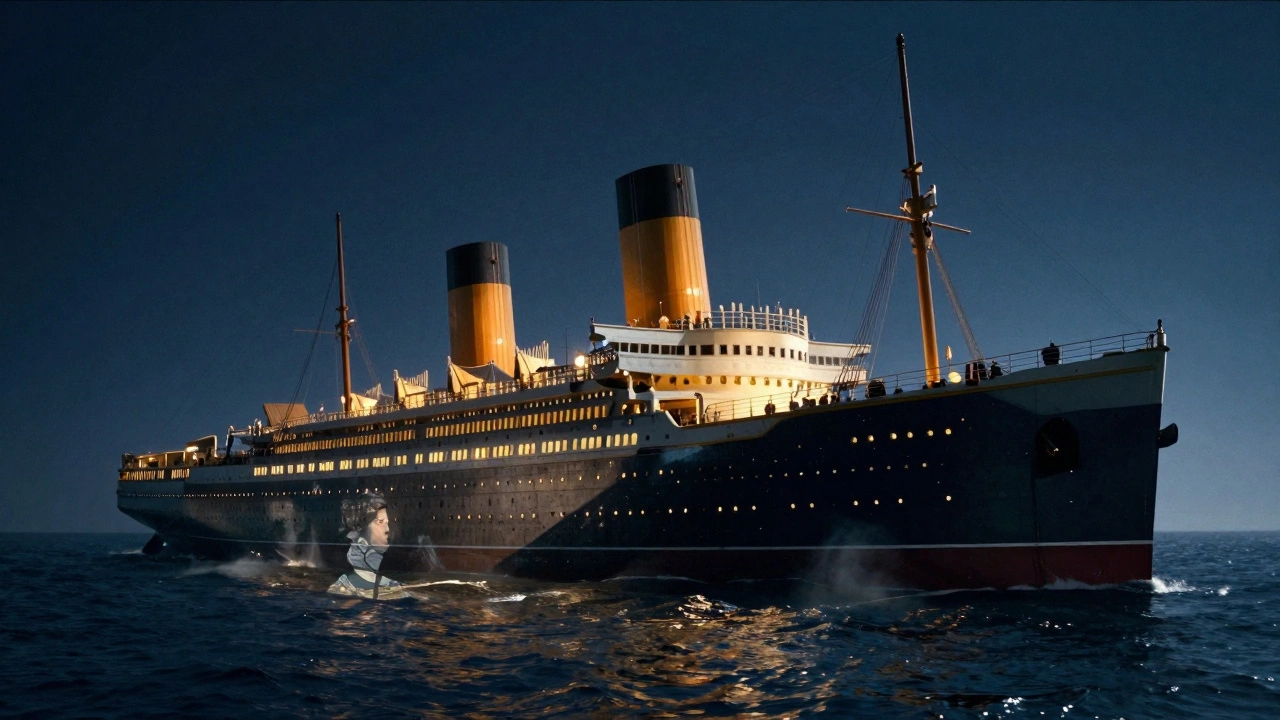
However, the sinking sequence takes some creative liberties. In the movie, the ship breaks in half and sinks relatively quickly. In reality, the breakup was less dramatic than depicted. The stern did break off, but it stayed attached longer than shown, and the final plunge was slower. More importantly, the water temperature is often misunderstood. The film shows people freezing instantly, which feels true, but the water was actually around 28°F (-2°C). Hypothermia sets in within minutes, but death doesn't happen immediately. Many survivors swam for over an hour before succumbing to the cold. The film compresses this timeline to heighten the urgency.
There is also the issue of the iceberg. In the movie, the collision seems sudden and catastrophic. Historically, the lookout, Frederick Fleet, spotted the iceberg four minutes away. At full speed, that gave the crew enough time to react, but not enough to stop. The ship scraped along the side of the iceberg, opening five bulkheads to the sea. This detail is accurate, but the film simplifies the structural failure. It wasn't one giant crack; it was a series of rivet failures and seam tears that let the water pour in. Cameron focuses on the visual impact rather than the engineering nuance.
| Element | In the Movie (1997) | Historical Fact |
|---|---|---|
| The Iceberg Collision | Sudden, violent impact with massive debris flying | A gentle scrape along the starboard side; no major debris |
| Lifeboats | Most boats leave nearly empty due to denial or chaos | Boats were lowered slowly because crew lacked training; many left with capacity underfilled |
| The Band | Plays "Nearer, My God, to Thee" as the ship goes down | Survivor accounts vary; most say they played light music like "Autumn" or "Lower, Deeper Down" |
| Breakup | Dramatic, quick snap in half | Slower separation; stern remained upright longer before diving |
Jack and Rose: Fictional Hearts in a Real Tragedy
Now, let’s talk about the elephant in the room-or rather, the couple on the bow. Jack Dawson and Rose DeWitt Bukater are entirely fictional. There was no young artist named Jack who drew Rose while she stood at the front of the ship. There was no wealthy heiress throwing her engagement ring into the ocean. Cameron created these characters to give audiences an emotional anchor. Without them, the film would be a documentary about a disaster. With them, it becomes a romance.
But does their existence distort the history? Not necessarily. Their journey mirrors the experiences of thousands of third-class passengers. Jack represents the steerage crowd-poor, optimistic, and ultimately trapped below decks as the ship fills with water. Rose represents the first-class elite-privileged, constrained by social norms, and initially unaware of the danger until it was too late. While Jack and Rose aren't real, their struggles reflect the class divide that played a huge role in who survived and who didn't.
One common myth sparked by the film is whether Jack could have fit on the floating door. For years, fans debated this. Physics experts have since confirmed that the wooden panel had enough buoyancy to support both Jack and Rose. Cameron has admitted this but argued that if Jack had lived, the story wouldn't work. It’s a classic case of narrative necessity overriding physical possibility. Remember, this is fiction dressed up as history. The point isn't to solve a physics problem; it's to tell a tragic love story.
The Real People Behind the Roles
While Jack and Rose are made up, many other characters in the film are based on real people. Some are portrayed accurately, while others are tweaked for drama. Let’s look at a few key figures.
Captain Edward Smith: In the movie, Captain Smith is shown standing at the helm as the ship sinks, choosing to go down with his vessel. This is historically accurate. Smith was found dead on the bridge, likely from exposure or heart failure. However, the film portrays him as somewhat passive and overwhelmed. In reality, Smith was an experienced captain with decades of service. He followed standard procedures, though critics argue he should have slowed down in ice-prone waters.
Thomas Andrews: The ship's designer, played by Victor Garber, is one of the most accurately portrayed characters. Andrews boarded the ship as a guest and realized the severity of the damage early on. He helped organize lifeboat launches and tried to save as many people as possible. His calm demeanor and technical knowledge in the film match survivor accounts. He died in the sinking, just like in the movie.
J. Bruce Ismay: The managing director of the White Star Line is depicted as a coward who sneaked onto a lifeboat. This portrayal is controversial. Ismay did survive by boarding Collapsible B, but he didn't sneak aboard. He was assisted by crew members and offered his seat to women, following the "women and children first" protocol. Public outrage after the disaster vilified him, and Cameron leaned into this negative reputation to create a clear villain. In reality, Ismay was a complex figure caught in a chaotic situation.
Molly Brown: Known as the "Unsinkable Molly Brown," she is shown as a loud, brash socialite who tries to take control of a lifeboat. This is largely accurate. Brown was indeed a prominent passenger who advocated for helping others and later testified against Ismay. Her character adds humor and energy to the film, but her real-life activism extended far beyond the sinking. She became a suffragette and philanthropist in Denver, Colorado.
Class Divide: Who Survived and Why?
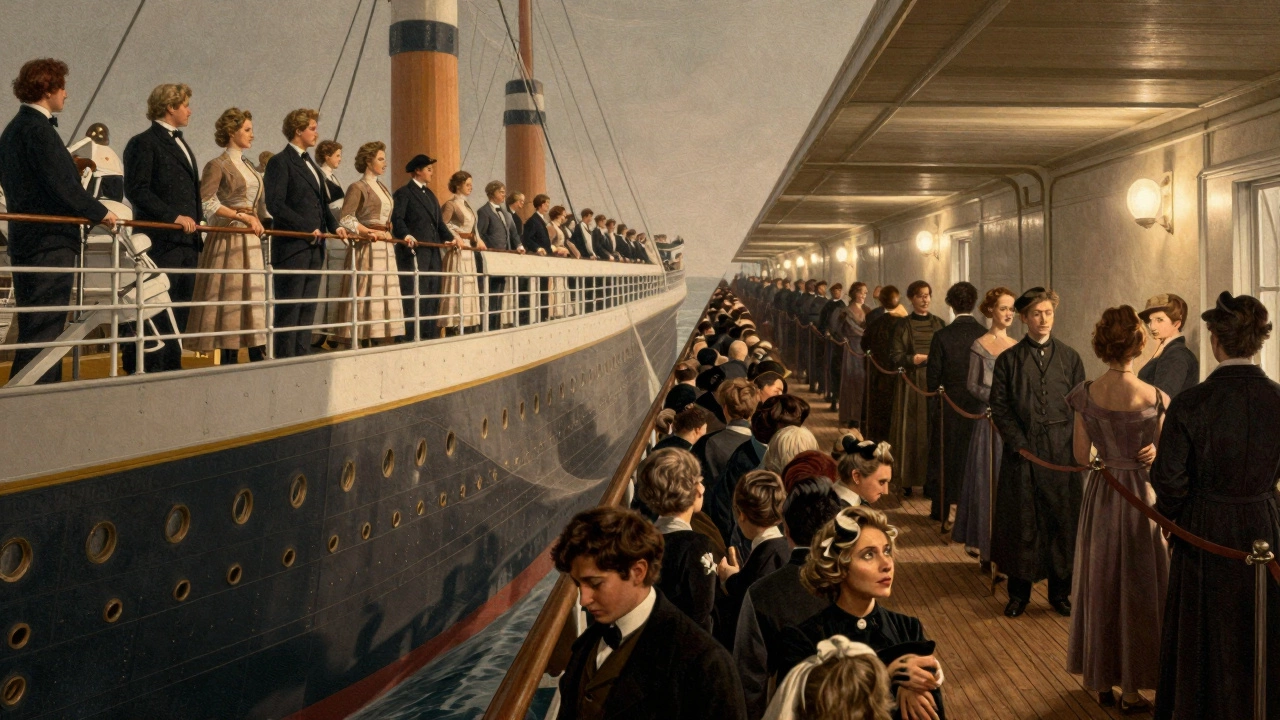
One of the most powerful aspects of the film is its depiction of class inequality. This is not just drama; it's hard fact. The survival rates varied drastically depending on your ticket class. First-class passengers had a 62% survival rate. Second-class passengers had a 41% survival rate. Third-class passengers? Only 25%. And crew members? Just 24%.
Why such a disparity? Partly because of location. First- and second-class cabins were closer to the lifeboats. Third-class passengers were housed deep in the ship, often behind locked gates (though evidence suggests these weren't all locked during the evacuation, access was still difficult). Many third-class passengers didn't even realize the gravity of the situation until it was too late. They were told to stay in their areas, waiting for instructions that never came.
The film shows this through Jack's struggle to reach Rose. He fights through corridors and stairwells blocked by panicked crowds and indifferent crew. This reflects the real experience of hundreds of steerage passengers. The tragedy wasn't just the sinking; it was the systemic neglect of the poor. Cameron uses Jack and Rose's relationship to highlight this divide, making the personal stakes feel universal.
Common Myths Debunked
Because the film is so popular, several myths have taken root. Let’s clear them up.
- Myth: The ship broke in two immediately.
Reality: The breakup occurred near the end of the sinking, about 20-30 minutes after the ship began to submerge. The stern remained above water for a significant period. - Myth: All the gold bars were lost.
Reality: The ship carried $1 million in gold coins (about $30 million today) in the safe. When the ship sank, the safe fell open, scattering the coins across the ocean floor. Divers have recovered some, but most remain underwater. - Myth: The band played "Nearer, My God, to Thee."
Reality: As mentioned earlier, survivor testimonies suggest they played lighter tunes. The hymn may have been sung by passengers, but the band likely stuck to upbeat music to keep morale high. - Myth: Jack froze to death instantly.
Reality: Hypothermia causes confusion, muscle weakness, and eventually unconsciousness. Jack would have lost feeling in his extremities first, then core body temperature dropped. It was painful and slow, not instantaneous.
Why Accuracy Matters in Historical Fiction
So, why does any of this matter? Isn't it enough that the movie was entertaining? For many, yes. But for those interested in history, understanding the distinction between fact and fiction is crucial. Cameron’s film brought unprecedented attention to the Titanic disaster. It funded further expeditions to the wreck site and inspired a new generation of historians. That’s a positive outcome.
However, when fiction replaces fact in public memory, we risk losing the lessons of the past. The Titanic disaster led to major changes in maritime safety laws, including the requirement for enough lifeboats for everyone and 24-hour radio monitoring. These reforms saved countless lives in future disasters. If we only remember the love story, we forget the regulatory failures that caused the tragedy.
Also, consider the human cost. Over 1,500 people died. Each had a name, a family, and a story. By focusing solely on fictional characters, we can inadvertently erase the voices of the real victims. The film does include brief glimpses of real passengers, but they are background figures. To truly honor the Titanic, we need to look beyond the screen and read the survivor accounts, study the inquiry reports, and understand the context of 1912.
Was there really a Jack Dawson on the Titanic?
No, Jack Dawson is a completely fictional character created by James Cameron for the 1997 film. There is no record of a passenger by that name on the manifest. He serves as a stand-in for the thousands of third-class passengers who perished.
Did the Titanic really sink in two hours?
Yes, the Titanic sank in approximately two hours and forty minutes after hitting the iceberg. The film accurately depicts the rapid pace of the sinking, although the exact timing of certain events, like the breakup, is compressed for dramatic effect.
Could Jack have survived on the door?
Physics experiments conducted by MythBusters and other experts have shown that the wooden door had enough buoyancy to support both Jack and Rose. However, James Cameron stated that Jack had to die for the story to work emotionally.
Was J. Bruce Ismay really a coward?
The film portrays Ismay as a coward, but historical records show he followed the "women and children first" protocol. He was assisted onto a lifeboat by crew members and offered his seat to women. His reputation suffered due to public outrage, not necessarily his actions during the evacuation.
What song did the band actually play?
Survivor accounts vary, but most agree the band played light music such as "Autumn" or "Lower, Deeper Down." The idea that they played "Nearer, My God, to Thee" is a persistent myth, likely stemming from passengers singing the hymn themselves.
How accurate is the depiction of the third-class conditions?
The film accurately portrays the cramped and basic conditions of steerage compared to first class. However, some critics argue it exaggerates the segregation. Third-class passengers were not locked behind gates during the evacuation, but they did face significant barriers in accessing the lifeboats due to language differences and lack of information.