
Author Fame Comparison Tool
Select any two authors to compare their fame across three key dimensions: commercial success, cultural presence, and historical longevity.
Fame Score Breakdown
Scores out of 10All Authors Ranked by Composite Fame Score
There is no single name that universally wins the title of "most famous author." It depends entirely on how you measure fame: by sales, by cultural impact, or by historical longevity. If we look at raw numbers, J.R.R. Tolkien and the creator of The Lord of the Rings often top the lists with over 150 million copies sold. But if we talk about who everyone has heard of, even if they’ve never read a word, William Shakespeare is an English playwright and poet widely regarded as the greatest writer in the English language remains the undisputed king. He wrote 39 plays and 154 sonnets more than 400 years ago, yet his phrases are still used in everyday conversation today.
Defining Fame: Sales vs. Cultural Presence
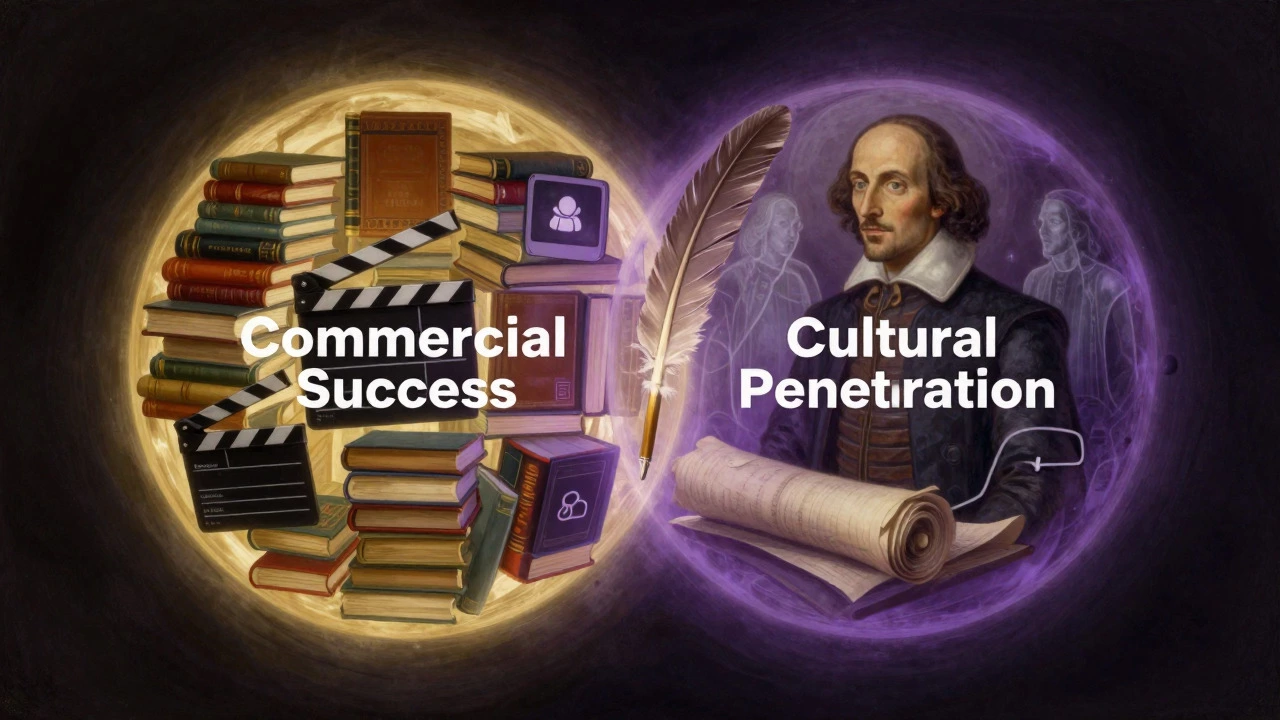
To answer this question honestly, we need to split "fame" into two distinct buckets. First, there is commercial success, measured by units sold. Second, there is cultural penetration, which measures how deeply an author’s work is embedded in the fabric of society. These two metrics rarely align perfectly. A modern blockbuster might sell millions in a year but fade from memory within a decade. A classic text might sell fewer copies annually but remain relevant for centuries.
When we look at commercial giants, the list changes dramatically. J.K. Rowling is a British author known for writing the Harry Potter series holds the record for the fastest-selling book series in history. Her works have sold over 600 million copies worldwide. Similarly, Aguirre da Silva, the Brazilian author of *The Alchemist*, has sold over 150 million copies. However, their fame is concentrated in the last 30 years. Ask someone in 1800 about Rowling, and they would be confused. Ask someone today about Shakespeare, and they will likely know at least one quote, even if they can’t name the play it came from.
The Historical Heavyweights
If we extend the timeline back further, the competition gets intense. Dante Alighieri wrote *The Divine Comedy* in the early 14th century, shaping Western literature and theology. His influence is profound, but he isn't a household name in the same way Shakespeare is. Then there is Homer, the ancient Greek poet credited with the *Iliad* and the *Odyssey*. These epics are among the oldest surviving works of Western literature. Homer’s fame is academic and foundational; every mythological reference traces back to him, but few people cite him in casual conversation.
Shakespeare stands apart because he bridges the gap between high art and popular culture. His characters-Hamlet, Macbeth, Juliet-are archetypes. When we say someone is "Romeo-like," we are referencing Shakespeare without realizing it. This linguistic integration is what cements his status. No other author has had such a direct impact on the vocabulary of the English-speaking world.
Modern Titans and Global Reach
In the contemporary era, fame is driven by media adaptation. Stephen King is an American author renowned for horror and supernatural fiction has sold over 350 million books. His name is synonymous with horror, and his works have been adapted into hundreds of films and TV shows. This constant visibility keeps his brand alive across generations. Similarly, Agatha Christie is often cited as the most published author in history, with her detective novels selling over 2 billion copies. Her stories are so ubiquitous that the mystery genre itself is defined by her structure.
However, global fame requires translation and cross-cultural appeal. Authors like Gabriel García Márquez, the Colombian master of magical realism, achieved massive international recognition, particularly after winning the Nobel Prize in Literature in 1982. His work introduced millions to Latin American literature, but his fame is more regional in its roots compared to the universal reach of Shakespeare or King.
| Author | Primary Era | Estimated Copies Sold | Type of Fame |
|---|---|---|---|
| William Shakespeare | 1564-1616 | ~200 Million (Est.) | Cultural/Linguistic Integration |
| J.K. Rowling | 1997-Present | 600+ Million | Commercial/Media Adaptation |
| Stephen King | 1974-Present | 350+ Million | Genre Dominance/Film Rights |
| Agatha Christie | 1920-1976 | 2+ Billion (Est.) | Volume/Global Distribution |
| J.R.R. Tolkien | 1937-1977 | 150+ Million | Fandom/World-Building Legacy |
Why Shakespeare Still Wins the General Vote
So, who takes the crown? If you ask a random person on the street in Sydney, London, or New York, "Who is the most famous author?" the answer is almost always William Shakespeare. Why? Because his work is invisible infrastructure. We use his words daily. "Break the ice," "heart of gold," "wild goose chase," "all that glitters is not gold"-these aren't just quotes; they are tools we use to communicate. This level of semantic integration is unmatched by any other writer, living or dead.
Modern authors like Rowling or King rely on active engagement. You have to watch the movie or buy the book to engage with them. Shakespeare is passive. He is woven into the language itself. This makes his fame durable. Trends change, genres evolve, and new stars rise, but the English language retains Shakespeare's fingerprints. For pure, unadulterated fame-the kind that doesn't require context or explanation-Shakespeare remains the benchmark.

The Role of Media in Shaping Perception
It is worth noting that fame is also manufactured by media cycles. In the 20th century, the rise of cinema turned authors into celebrities. Before film, an author was a figure of intellect. Now, they are often figures of entertainment. This shift benefits living authors. They get interviews, social media presence, and merchandise. Shakespeare didn't have Instagram. He had no chance to build a personal brand. Yet, despite these disadvantages, his legacy persists. This suggests that while media boosts current popularity, it is the depth of the work that ensures long-term fame.
Conclusion: It Depends on Your Definition
Ultimately, the title of "most famous author" is subjective. If you value sales volume, Agatha Christie or J.K. Rowling might edge out others. If you value cultural ubiquity, Shakespeare is the clear winner. If you value academic respect, Homer or Dante might claim the spot. But for the general public, the name that resonates instantly, across borders and centuries, is still the Bard from Stratford-upon-Avon. He didn't just write stories; he helped build the language we use to tell them.
Has any author sold more books than Shakespeare?
Yes. Modern authors like J.K. Rowling, Stephen King, and Agatha Christie have significantly higher verified sales figures. Shakespeare's exact sales numbers are difficult to calculate due to the age of his works and various editions, but modern commercial successes have surpassed him in raw unit count.
Why is Shakespeare considered more famous than Homer?
While Homer is historically significant, Shakespeare's works are written in the English language, which is currently a global lingua franca. Additionally, Shakespeare's plays are performed frequently around the world, keeping his name in active circulation, whereas Homer's works are primarily studied in academic contexts.
Does being translated affect an author's fame?
Absolutely. Translation expands an author's audience beyond their native language speakers. Authors like Gabriel García Márquez gained massive global fame partly because their works were translated into dozens of languages, allowing readers worldwide to access their unique storytelling styles.
Can a living author ever surpass Shakespeare in fame?
It is highly unlikely in the near future. Shakespeare's fame is rooted in linguistic integration and centuries of cultural reinforcement. While a living author may have more immediate recognition, matching the depth of Shakespeare's impact on the English language would take several generations of continued relevance.
What defines 'cultural fame' versus 'commercial fame'?
Commercial fame is measured by sales, royalties, and market share. Cultural fame is measured by how much an author's work influences language, idioms, education, and other art forms. An author can be commercially successful without being culturally pervasive, and vice versa.