Mythology Lens: Ancient vs. Modern Interpretation
Select a Topic
Choose an aspect of the story to see how its meaning shifts between time periods.
Medusa's Identity
In the earliest myths (like Hesiod), Medusa was born a Gorgon—a monstrous creature with snakes for hair. She was not a victim, but a dangerous entity destined to be slain by heroes like Perseus to restore order.
Medusa is reinterpreted as a tragic victim of sexual violence. Her transformation is seen as a metaphor for societal victim-blaming, where her trauma turns her into a "monster" in the eyes of a patriarchal system that silences women.
Did Athena, the goddess of wisdom and war, actually hate Medusa?
It is a question that haunts anyone who has read the myths. We picture a cold, distant goddess cursing a beautiful woman into a monster because she was offended. But if you look closer at the ancient texts, the story isn't about petty jealousy or random cruelty. It is about violation, sacred space, and the brutal justice of the gods.
To understand why Athena punished Medusa, we have to stop looking at them as enemies and start looking at them as victims of a larger cosmic order. The hatred wasn't personal in the way we think of it today. It was structural. It was about what happens when the boundaries between the divine and the mortal are crossed with violence.
The Sacred Space: More Than Just a Temple
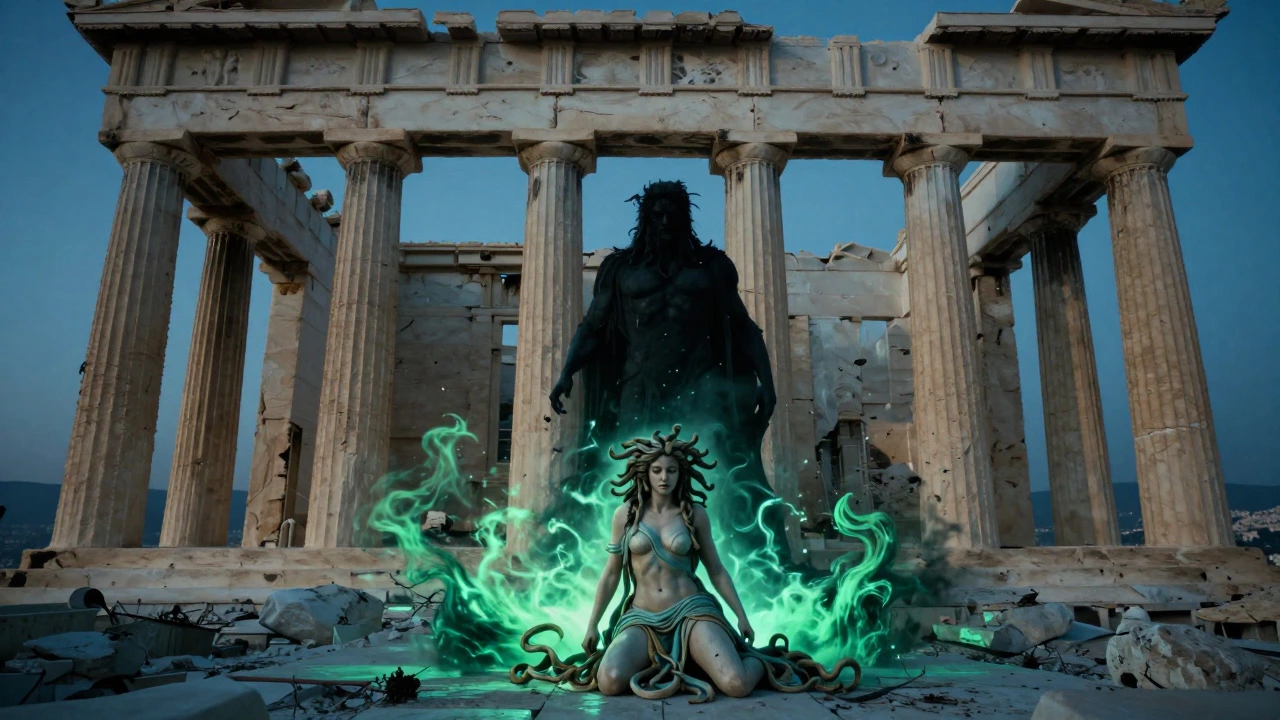
You cannot understand the punishment without understanding the crime. And the crime didn't happen in a bedroom or a field. It happened in the Temple of Athena in Athens, a sacred sanctuary dedicated to the goddess of wisdom and strategic warfare.
In ancient Greece, temples weren't just buildings. They were the physical homes of the gods. To enter one was an honor; to defile one was a catastrophe. The concept of Hubris excessive pride or arrogance toward the gods, often leading to downfall is central here, but so is the idea of pollution. Sexual violence inside a temple wasn't just a crime against a person. It was a crime against the city, the state, and the divine order itself.
When Poseidon the god of the sea, earthquakes, and horses, one of the twelve Olympians forced himself on Medusa in Athena's temple, he didn't just assault a priestess. He desecrated Athena's home. Imagine someone smashing your favorite vase while you're away, then blaming you for being upset when you come back. That is the dynamic at play. Athena’s anger was directed at the violation of her sanctity.
Who Was Medusa Before the Curse?
We need to clear up a major misconception right away. In the earliest versions of the myth, Medusa wasn't a victim. She was a Gorgon from birth-a monstrous creature with snakes for hair and bronze wings, destined to be killed by heroes like Perseus a Greek hero who slew Medusa and Andromeda.
But later poets, particularly Ovid in his Metamorphoses, changed the narrative. They gave Medusa a backstory. In this version, Medusa was once a beautiful mortal woman, perhaps even more beautiful than Athena herself. She was a priestess of Athena, sworn to celibacy. This detail is crucial. As a priestess, she belonged to the goddess. Her body was considered sacred property of the temple.
This shift in the myth reflects a change in how Greeks viewed female agency and divine protection. By making Medusa a former beauty turned monster, the myth becomes a tragedy rather than a simple monster-slaying tale. It raises the stakes. If Medusa was innocent, why did Athena punish her instead of Poseidon?
The Problem with Poseidon
Here is where the logic gets tricky. Why didn't Athena just go after Poseidon? After all, he was the aggressor. He was the one who broke into the temple. He was the one who committed the rape.
The answer lies in the hierarchy of the gods. You don't easily punish another Olympian. Poseidon was Athena's uncle (or brother, depending on the genealogy). He was powerful, chaotic, and untouchable. To strike down Poseidon would risk a war among the gods that could shake the earth apart-literally, since he controls earthquakes.
So, Athena had a choice. She could let the desecration stand, which would make her look weak and ineffective as a protector of Athens. Or she could enforce justice within the limits of her power. Medusa was mortal. Medusa was the one present in the temple. Medusa was the "pollution" that needed to be removed.
It sounds unfair to us. It feels like victim-blaming. And in many ways, it is. But in the context of ancient mythological logic, the presence of the act in the sacred space made Medusa complicit in the eyes of the law, even if she was physically overpowered. The temple was polluted by her presence during the act. To cleanse the temple, the pollution had to be transformed.
The Transformation: Mercy or Cruelty?
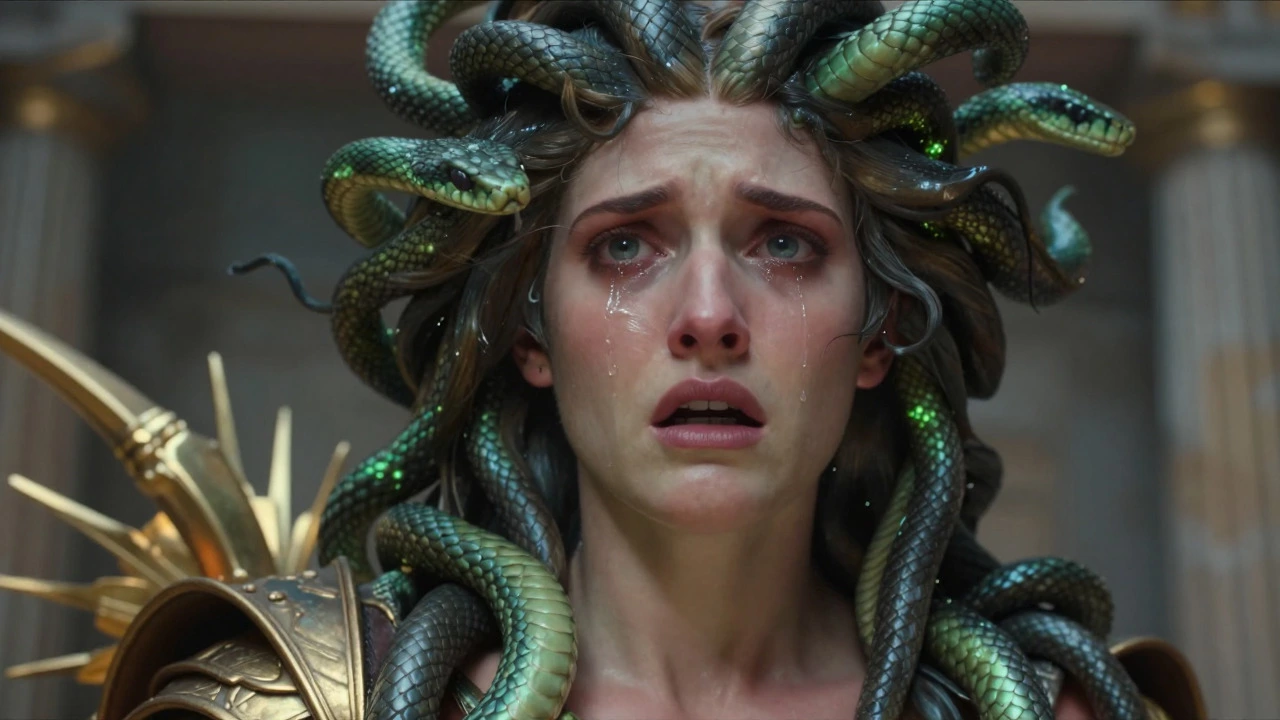
Athena’s curse is often described as turning Medusa’s hair into snakes and her gaze into stone. But some interpretations suggest this was a twisted form of protection. Think about it. Medusa had been violated by a god. She was vulnerable. By turning her into a monster, Athena made her invulnerable. No man could touch her again without dying. No god could easily harm her.
However, this "protection" came at the cost of her humanity. She was exiled to the ends of the earth, alone, feared by all. This duality is key to understanding Athena’s role. She is not a nice goddess. She is a goddess of war and strategy. Her solutions are often extreme, permanent, and devoid of emotional warmth. She solved the problem of the desecrated temple by removing the source of the pollution permanently.
The transformation also serves as a warning. It shows the danger of crossing boundaries. For mortals, the lesson is clear: respect the sacred, or face consequences beyond your comprehension. For other gods, it was a reminder that Athena guards her domain fiercely.
Perseus and the Final Act
The story doesn't end with the curse. It ends with Perseus son of Zeus and Danaë, tasked with retrieving Medusa's head. Zeus, Poseidon’s father and king of the gods, tasks Perseus with killing Medusa. Why? Some say it was to help Perseus prove his worth. Others suggest it was a way to finally remove the stain from Athena’s temple, now that the threat was contained.
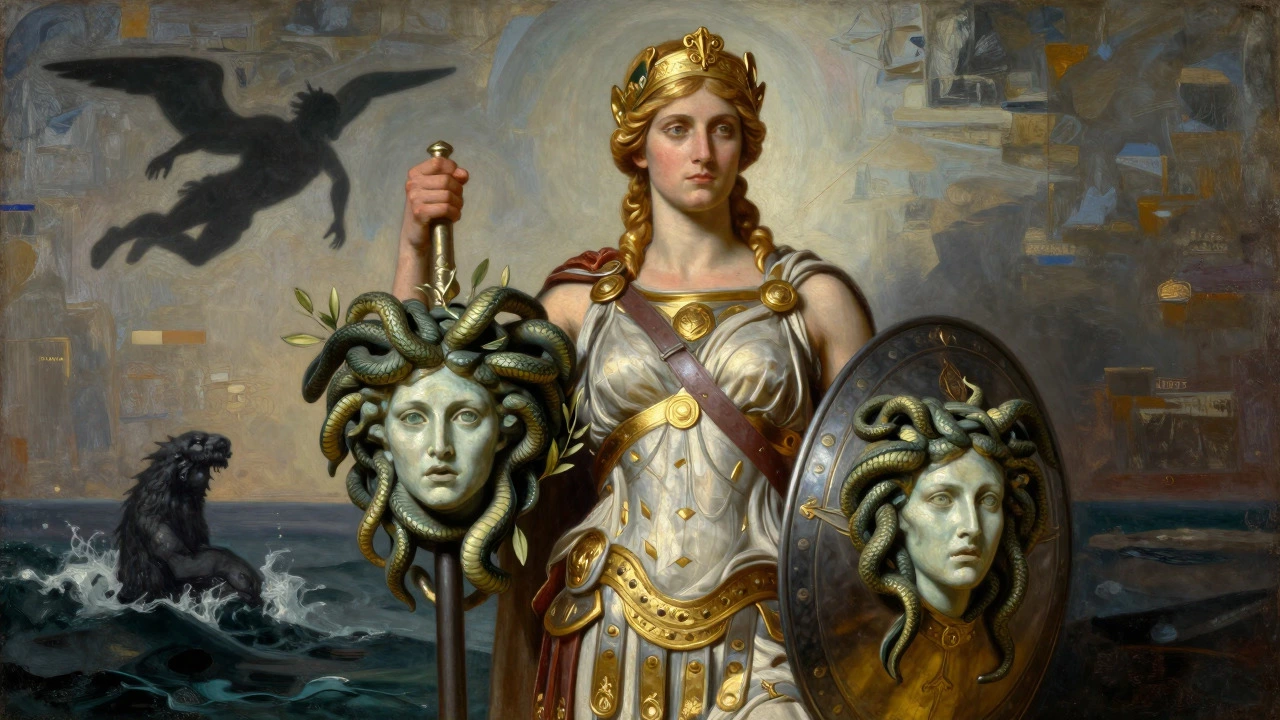
Athena helps Perseus. She gives him a polished shield to reflect Medusa’s gaze, avoiding direct eye contact. She guides him to the Graeae, three old women who share one eye and one tooth, to get directions. This collaboration is significant. Athena isn't hiding from her creation. She is actively participating in its destruction. This suggests that her relationship with Medusa was never about love or hate, but about duty. Medusa was a problem to be managed, first by containment, then by elimination.
When Perseus cuts off Medusa’s head, Athena places it on her shield, the Aegis a protective cloak or shield worn by Zeus and Athena, often featuring the head of Medusa. This is the ultimate symbol of their relationship. Medusa’s terror becomes Athena’s weapon. The victim’s pain is repurposed as divine power. It is efficient. It is strategic. And it is chilling.
Modern Interpretations: Feminism and Trauma
In recent years, the myth of Medusa has been reclaimed by feminist scholars and artists. They argue that Medusa represents the silenced voice of women whose trauma is ignored or blamed on them. Athena, in this view, represents patriarchal structures that prioritize order and reputation over individual justice.
Is this fair to Athena? Maybe not entirely. Athena is a complex figure. She champions women like Arachne a mortal weaver who challenged Athena to a contest (though she punishes her too) and supports heroes like Odysseus. But her treatment of Medusa remains her darkest hour. It highlights the limitations of divine justice when it intersects with gender and power dynamics.
Today, we see Medusa not just as a monster, but as a survivor. Her snakes represent resilience. Her gaze, which turns men to stone, represents the power to silence those who seek to objectify or harm. Athena’s role shifts from villain to enabler of a system that failed Medusa. This modern lens adds depth to the ancient text, forcing us to ask uncomfortable questions about who holds power and who pays the price.
Comparison: Ancient vs. Modern Views
| Aspect | Ancient Greek View | Modern Interpretation |
|---|---|---|
| Medusa's Identity | Born monster or cursed priestess | Victim of sexual violence and systemic failure |
| Athena's Motive | Protecting sacred space and divine order | Patriarchal enforcement and victim-blaming |
| Poseidon's Role | Aggressor, but largely unpunished due to status | Symbol of unchecked male privilege |
| The Curse | Punishment for pollution of the temple | Erasure of female identity and trauma |
| Outcome | Restoration of order through Perseus | Reclamation of Medusa as a symbol of resistance |
Key Takeaways
- It wasn't personal hate: Athena’s actions were driven by the need to protect her temple and maintain divine order, not personal animosity toward Medusa.
- Sacred space matters: The location of the assault (Athena’s temple) was the primary trigger for the curse, highlighting the importance of religious sanctity in ancient Greece.
- Hierarchy of power: Poseidon escaped severe punishment because he was a major god, leaving Medusa, a mortal, to bear the consequences.
- Evolution of the myth: Early myths portrayed Medusa as a born monster; later versions humanized her, adding layers of tragedy and injustice.
- Modern relevance: Today, Medusa is seen as a symbol of female resilience and the failures of systems that blame victims for their trauma.
Frequently Asked Questions
Did Athena hate Medusa personally?
Not in the emotional sense. Athena’s actions were motivated by the desecration of her temple. In ancient Greek thought, the violation of sacred space required immediate and severe correction. Athena’s "hatred" was more about enforcing divine law and protecting her domain than personal dislike of Medusa as an individual.
Why didn't Athena punish Poseidon?
Poseidon was one of the Twelve Olympians, a major god with immense power. Punishing him directly could have led to conflict among the gods. Additionally, the hierarchy of the divine realm protected higher-status deities from the same level of scrutiny applied to mortals. Medusa, being mortal and present in the temple, became the focal point of the "pollution" that needed to be addressed.
Was Medusa always a monster?
In the earliest Greek myths, such as those by Hesiod, Medusa was born a Gorgon, a monstrous creature. However, later Roman poet Ovid introduced the version where Medusa was a beautiful mortal woman who was cursed by Athena. This later version has become more popular in modern culture due to its tragic elements.
What does Medusa symbolize today?
Today, Medusa is often viewed as a symbol of female empowerment, resilience, and survival. Many feminists interpret her story as a metaphor for the silencing of women and the societal tendency to blame victims of sexual violence. Her ability to turn men to stone is seen as a reclaiming of power and a defense mechanism against further harm.
How did Perseus kill Medusa?
Perseus used a polished shield given to him by Athena to reflect Medusa’s image, allowing him to approach her without looking directly at her eyes. He also received help from the Graeae and wore winged sandals. With these aids, he beheaded Medusa while she slept, ensuring he avoided her petrifying gaze.
Where is Medusa's head now in the myth?
After Perseus decapitated Medusa, he gave her head to Athena. Athena placed it on her Aegis, a protective shield or cloak. The head served as a terrifying weapon that could turn enemies to stone, enhancing Athena’s power in battle and serving as a constant reminder of the consequences of violating sacred spaces.
Is the story of Medusa based on real events?
There is no historical evidence that Medusa existed as a real person. The story is a myth created to explain natural phenomena, cultural values, and religious beliefs. However, some theories suggest that the Gorgons may have originated from ancient tribal masks or symbols used in rituals, which were later incorporated into Greek mythology.
What is the significance of the Temple of Athena in the story?
The Temple of Athena represents the sacred boundary between the divine and the mortal worlds. Its desecration by Poseidon and Medusa was a profound insult to Athena’s authority and purity. The location of the event is critical because it transforms a personal assault into a religious crisis, necessitating a divine response to restore order and sanctity.