
Pandora vs. Eve: Myth Comparison Tool
Explore the parallels and key differences between these two iconic origin stories.
| Feature | Pandora (Greek) | Eve (Biblical) |
|---|---|---|
| Creator | Hephaestus (with help from other gods like Athena & Aphrodite) | God (created from Adam's rib) |
| Motive | Punishment for men (Zeus's revenge for stolen fire) | Companionship for Adam (to not be alone) |
| The Object | Jar (Pithos) containing evils | Tree of Knowledge in the Garden of Eden |
| Temptation | Internal (built-in curiosity & deceit by Hermes) | External (The Serpent tempts her) |
| Result | Evil released; Hope remains inside the jar | Sin entered; expulsion from Eden; death introduced |
| Status | First woman in Hesiod's version only | First woman in Abrahamic faiths |
Key Takeaways
A "Beautiful Evil"
Pandora was crafted specifically as a trap to punish humanity, whereas Eve was created out of love and need for companionship.
Jar vs. Tree
The mistranslation of 'pithos' (jar) to 'pyxis' (box) changed history. Pandora opened a massive storage vessel, not a jewelry box.
Ambiguous Hope
Unlike the clear fall of man in Genesis, Pandora's myth leaves us debating whether Hope staying in the jar is a blessing or a curse.
You’ve probably heard the story. A box, a curious woman, and all the evils of humanity unleashed upon the world. But here is the question that trips up most people: Was Pandora actually the first woman created by the gods?
The short answer is yes. In the specific version of Greek mythology written down by the poet Hesiod around 700 BCE, Pandora was indeed the very first female human. Before her, men lived in a golden age without women, disease, or toil. She wasn’t just a random character; she was a deliberate creation designed to punish humanity.
But the long answer is messier. Myths aren’t history books. They shift, change, and contradict each other depending on who is telling them. To really understand if Pandora was the "first," we have to look at where this idea comes from, why it matters, and how it compares to other origin stories like the Biblical Eve.
The Source: Hesiod’s Two Books
When we talk about Pandora being the first woman, we are almost exclusively talking about two poems written by Hesiod. He was an ancient Greek poet from Boeotia, and his works, Theogony and Works and Days, are our primary sources for this specific narrative. Without Hesiod, Pandora might just be a minor footnote.
In Theogony, Hesiod gives us the background. Zeus, the king of the gods, is angry with Prometheus because Prometheus stole fire and gave it to humans. This act made life easier for mortals but upset the divine hierarchy. So, Zeus decides to give humanity a "beautiful evil" to balance out the gift of fire.
This is where Pandora enters the scene. She isn’t born; she is crafted. Hephaestus, the god of craftsmanship, molds her from earth and water. Athena, the goddess of wisdom, dresses her. Aphrodite puts grace and desire on her. Hermes teaches her deceitful speech. Every major Olympian god contributes something to her makeup. She is literally a composite of divine powers, designed to be irresistible yet dangerous.
In Works and Days, Hesiod expands on this. Here, he explicitly states that before Pandora, men lived without women. They were essentially self-sustaining or perhaps born from the earth directly (like the Spartoi in other myths). Pandora is introduced as the progenitor of the female race. Her arrival marks the end of the Golden Age and the beginning of the Iron Age, a time of hardship and sorrow.
Why "Pandora"? The Name Matters
The name itself tells you everything you need to know about her role. In Ancient Greek, pân means "all" and doron means "gift." So, Pandora translates to "All-Gifted" or "She who has all gifts."
This is ironic, to say the least. While she possesses every gift the gods could offer-beauty, charm, intelligence-she brings disaster to mankind. Some scholars argue that her name was a later rationalization. Maybe she was originally called Apandra, meaning "no gift," which would make more sense given her destructive impact. But Hesiod sticks with "All-Gifted," emphasizing the trap. You can’t refuse a gift that contains everything desirable. That’s the psychological hook.
The Jar (Not the Box)
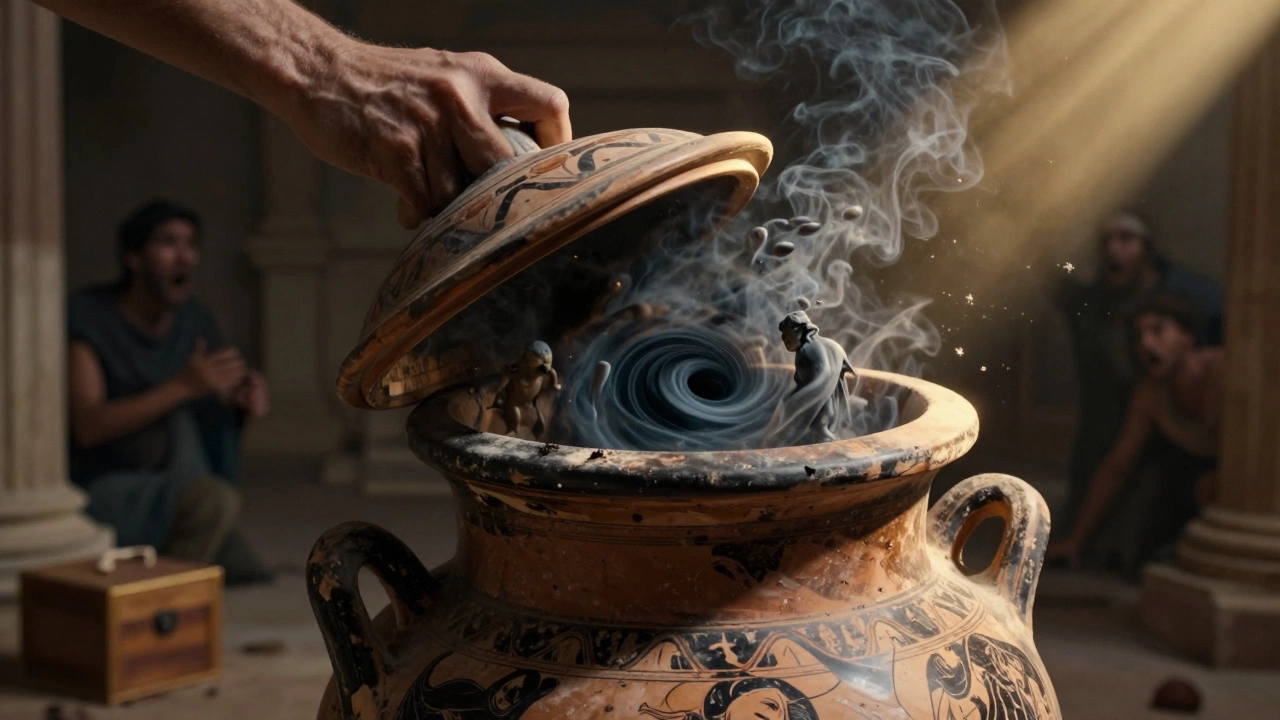
Here is a common misconception that needs clearing up immediately. Pandora didn’t open a box. She opened a jar.
The original Greek word used by Hesiod is pithos. This refers to a large storage vessel, typically made of clay, used for holding wine, oil, or grain. It’s a big jar, not a small wooden chest. Somewhere along the line, in the 16th century, Erasmus of Rotterdam translated pithos as pyxis, which means "box" or "chest." This translation error stuck, and now everyone imagines a jewelry box instead of a massive storage urn.
Why does this matter? Because a pithos implies containment of bulk goods. It suggests that the "evils" inside were meant to be stored away, hidden from human sight. When Pandora lifts the lid, she doesn’t just release a few bad vibes; she unleashes a flood of diseases, death, and labor into the world. Only Hope (Elpis) remains inside when she closes the lid. Whether Hope is trapped to protect us or denied to us is one of the biggest debates in classical scholarship.
Was She Really the First? Other Greek Views
Hesiod had a lot to say about women. He was famously misogynistic, viewing women as a necessary evil. But he wasn’t the only voice in ancient Greece. If you look at other poets, the picture gets blurry.
For example, Homer, who wrote earlier than Hesiod (or around the same time, depending on how you date the oral tradition), never mentions Pandora. In the Iliad and Odyssey, women exist naturally. Helen of Troy, Penelope, Circe-they are born, not manufactured. There is no mention of a singular first woman created by Hephaestus. For Homer, the gender divide isn’t a punishment; it’s just part of the natural order.
Then there’s the myth of Pyrrha and Deucalion. After Zeus sends a great flood to wipe out humanity, only Deucalion and his wife Pyrrha survive. They repopulate the earth by throwing stones over their shoulders, which turn into new humans. In this version, women don’t start with Pandora; they restart with Pyrrha. This suggests that different city-states and cults had different origin stories. Hesiod’s version was popular in certain agricultural contexts (since Works and Days is partly farming advice), but it wasn’t universal dogma.
Pandora vs. Eve: Parallel Stories
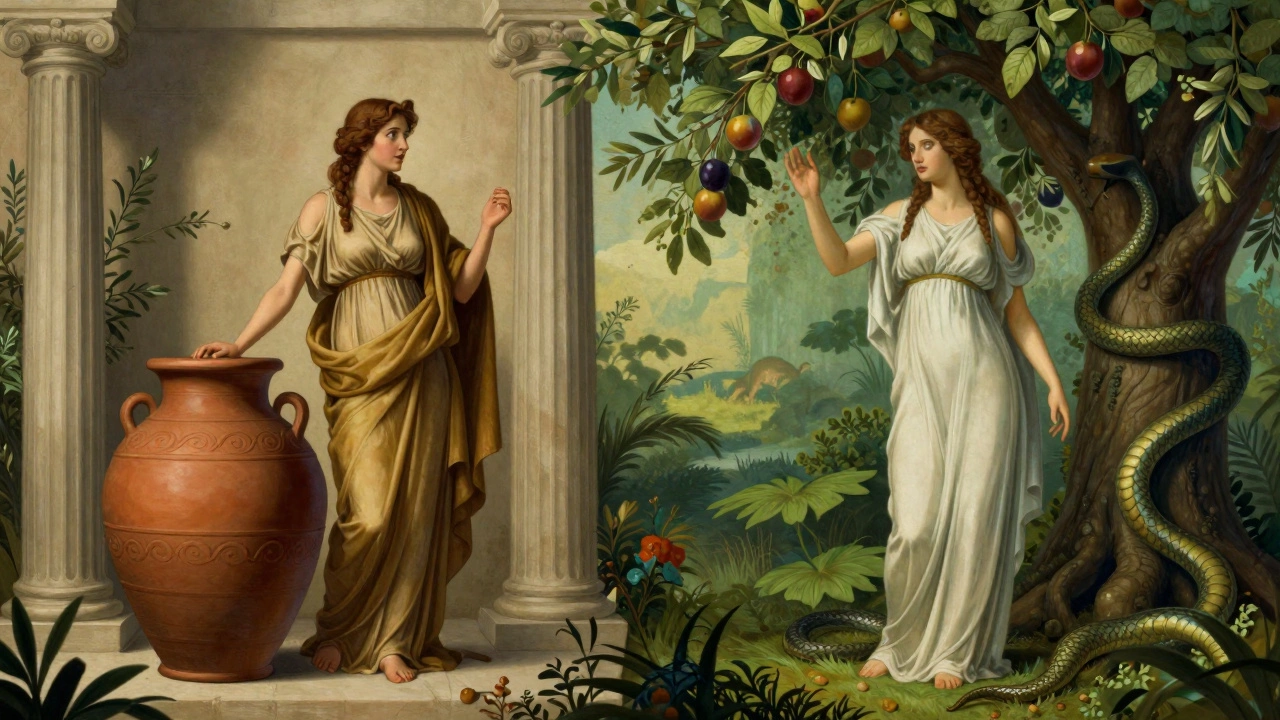
If you grew up in a Western culture, the story of Pandora feels familiar because it mirrors the Biblical story of Eve. Both involve:
- A first woman created specifically by a divine power.
- A prohibition against interacting with a specific object (the jar/tree).
- Curiosity leading to disobedience.
- The introduction of suffering, death, and labor into the world.
However, the theological implications are totally different. In the Genesis account, Eve is created from Adam’s rib as a companion. She is equal in status, though subordinate in the narrative structure. The serpent tempts her, introducing an external agent of deception. In Hesiod’s version, there is no serpent. Pandora *is* the deception. She is built by the gods themselves to trick men. There is no external tempter; the trap is baked into her design.
Also, consider the outcome. In Christianity, the fall leads to original sin, requiring redemption through Christ. In Greek myth, there is no redemption arc for Pandora’s mistake. The evils stay out. Humans just have to deal with them. It’s a much bleaker worldview. Hesiod isn’t offering a path back to Eden; he’s explaining why your back hurts after plowing fields all day.
The Cultural Impact: Blaming Women
Why did this myth stick? Why do we still talk about "Pandora’s Box" today?
It serves a social function. In ancient patriarchal societies, the myth justified male dominance. By framing women as a divine punishment-a "necessary evil" sent by Zeus-it provided a religious rationale for keeping women subservient. Hesiod writes explicitly that women are a burden to men, comparing them to ants that steal food while working hard themselves.
Modern feminism has rightly critiqued this. Scholars like Mary Lefkowitz have pointed out that Hesiod’s view was not representative of all ancient Greek thought. Women in Athens had legal rights, owned property, and played key roles in religious festivals. The myth is more of a literary device than a historical record of social reality.
Yet, the phrase "Pandora’s Box" survives because it’s useful. We use it to describe any action that seems harmless but leads to unforeseen chaos. Opening a new technology, signing a treaty, releasing a product-any decision that unleashes uncontrollable consequences gets labeled as opening Pandora’s Box. The gender aspect often fades away in modern usage, leaving just the concept of irreversible risk.
So, Who Was the First Woman?
If you’re asking strictly within the framework of Hesiod’s poetry, then yes, Pandora was the first woman. She was the prototype, the template for all subsequent females. Her creation marked the transition from a mythical past of ease to a present of struggle.
But if you’re looking at Greek mythology as a whole, the answer is no. Women existed before her in other traditions. They were born, married, and died without reference to a clay-and-water origin. And if you’re looking at history, obviously, women have always existed alongside men. The myth is a metaphor for the complexity of human relationships, not a biological fact.
Understanding Pandora requires accepting that she is a symbol. She represents the danger of curiosity, the unpredictability of gifts, and the inherent difficulties of coexistence between genders. She is the first woman in one man’s poem, but she is far from the only woman in the history of ideas.
| Feature | Pandora (Greek/Hesiod) | Eve (Biblical/Genesis) |
|---|---|---|
| Creator | Hephaestus (with help from other gods) | God (from Adam's rib) |
| Motive | Punishment for men (Zeus's revenge) | Companionship for Adam |
| The Object | Jar (Pithos) | Tree of Knowledge |
| Temptation | Internal (built-in curiosity/deceit) | External (The Serpent) |
| Result | Evil released; Hope remains inside | Sin entered; expulsion from Eden |
| Status | First woman in Hesiod's version | First woman in Abrahamic faiths |
Frequently Asked Questions
Was Pandora the first woman in all Greek mythology?
No. Pandora is the first woman only in the specific works of the poet Hesiod (Theogony and Works and Days). Other Greek poets, such as Homer, feature women who are born naturally without reference to a divine creation event. Different regions of Greece had varying local myths about origins.
Did Pandora open a box or a jar?
She opened a jar. The original Greek word used by Hesiod is pithos, which refers to a large clay storage vessel. The idea of a "box" came from a mistranslation by Erasmus in the 16th century, who confused pithos with pyxis (box).
Who created Pandora and why?
Zeus ordered her creation as punishment for humanity after Prometheus stole fire from the gods. Hephaestus molded her from earth and water, while other gods like Athena, Aphrodite, and Hermes added beauty, grace, and deceitful speech. She was designed to be a "beautiful evil" to counteract the benefit of fire.
What is the difference between Pandora and Eve?
While both stories involve a first woman causing suffering, the motives differ. Eve was created as a companion and tempted by an external serpent. Pandora was created specifically as a trap/punishment by the gods themselves, with deceit built into her nature. Additionally, Pandora opened a jar containing evils, whereas Eve ate fruit from a forbidden tree.
What does "Pandora's Box" mean today?
The phrase is used metaphorically to describe an action that seems innocent but leads to unexpected and uncontrollable problems. It highlights the risk of unleashing forces that cannot be contained once released.
Is Hope good or bad in the Pandora myth?
This is debated among scholars. Some believe Hope remained in the jar to comfort humans amidst their suffering, acting as a positive force. Others argue that Hope is also an evil, kept inside to prevent humans from having false expectations, thus making their lives even harder. Hesiod leaves it ambiguous.